Little Italy is one of those Toronto neighbourhoods that actually delivers on its name. The College Street strip hums with espresso bars, family-run trattorias, gelaterias older than your grandparents, and patios that spill onto the sidewalk from May through October. Just behind the main drag sits a quiet residential pocket of Victorian and Edwardian homes on tree-lined streets, with Trinity Bellwoods to the west and Kensington Market a short walk east. For buyers who want downtown energy without giving up character or community, this stretch of College Street earns its loyal following.
Overview
Little Italy runs along College Street West, roughly from Bathurst over to Ossington, with Harbord Street capping it off to the north and Dundas Street to the south. Step north across Harbord and you are quickly into The Annex, while heading west drops you straight into Trinity Bellwoods. The official city neighbourhood is Palmerston-Little Italy, which folds in a chunk of the leafy residential streets above College and the grand Edwardian boulevards around Palmerston Avenue.
The strip itself is centred on a couple of dozen blocks of restaurants, cafés, gelaterias, bars, and indie shops, with the 506 Carlton streetcar running right down the middle. Step off the main road and you land on streets lined with Victorian semis, Bay-and-Gable row houses, and the occasional grand Edwardian mansion. It is the kind of downtown pocket where you can grab an espresso, walk your dog through Trinity Bellwoods Park, and be home in time for dinner.
History
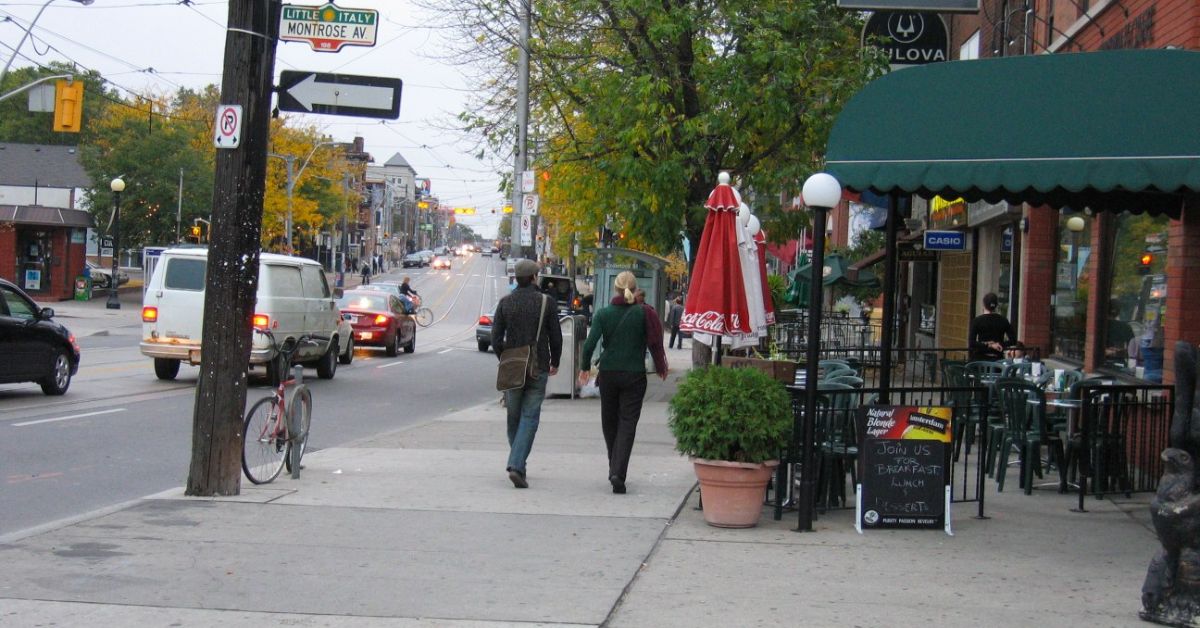
Image Credit: Alain Rouiller – Toronto Little Italy 19 – CC BY-SA 2.0/Wikimedia Commons
Italians began arriving in Toronto in large numbers in the early 1900s, with the first wave settling around University Avenue and College in what was then called The Ward. As that area redeveloped, the community shifted west along College Street, and by the 1920s this stretch was the recognized heart of Italian Toronto. Cafés, social clubs, grocers, and bakeries clustered along College and gave the strip the character that still defines it.
By the 1960s, many Italian families had moved north to Corso Italia on St. Clair West or out to the suburbs in Woodbridge and Vaughan. Their move opened space for Portuguese, Spanish, Latin-Canadian, Chinese, and Vietnamese families, and the area took on the layered, multicultural feel it has today. In 1985, the local business association formally adopted the Little Italy name to honour the neighbourhood’s role as the original landing pad for Italians in Toronto.
The Victorian and Edwardian housing stock from those early decades is largely still standing, which is part of why the area feels so distinct. Bay-and-Gable row houses, brick semis, and grand boulevard mansions sit on the same streets they did a century ago. Buying into Little Italy is, in a real sense, buying into one of Toronto’s longest-running immigration stories.
What Is Little Italy Most Famous For?
Plenty, for a neighbourhood barely a kilometre long. Little Italy is famous for its summer festival, its old-school Italian cafés, its independent cinema, and the broader cultural footprint Italians built into Toronto from this corner of College Street. Here are the highlights worth knowing before you settle in.
Taste of Little Italy
Every June, College Street shuts down to traffic for Taste of Little Italy, a three-day street festival that has been running for over three decades. Tens of thousands of people show up to graze on cannoli, arancini, fresh pasta, and gelato while live music and DJs play from outdoor stages. It is the kind of weekend that turns a regular block of College into a giant outdoor dinner party.
Local restaurants set up sidewalk stations, family vendors line the curb, and the whole strip takes on a holiday feel. Carnival rides, art installations, and pop-up patios round out the weekend, with something running from morning until past midnight. For people who live here, it is the unofficial start of summer and one of the biggest reasons the neighbourhood gets booked solid that weekend.
Café Diplomatico

Image Credit: Cafe Diplomatico
Café Diplomatico, or simply the Dip to regulars, has been parked at the corner of College and Clinton since 1968. Its big, sprawling patio is one of the most recognized in the city, and it has anchored the strip’s social scene through every wave of change Little Italy has seen. Plenty of Torontonians have ordered their first espresso or first slice of takeout pizza here.
Inside, the décor is unfussy and the menu sticks to what works, including thin-crust pizza, simple pasta, and proper Italian coffee. The Dip turns up in countless Toronto films and music videos, which has only added to its low-key landmark status. For locals, it doubles as a meeting spot, a quick lunch, and the place to watch World Cup games when Italy is playing.
Sicilian Sidewalk Café

Image Credit: Trip.com
The Sicilian Sidewalk Café has been scooping gelato at the corner of College and Manning since 1959, making it the oldest authentic gelato shop in Toronto. The four Galipo brothers opened it as a meeting spot for the city’s growing Italian community, and that gathering-place role has never really gone away. The window still pulls a queue down the block on warm summer nights.
The flavours are old-school and made in-house, with classics like pistachio, hazelnut, and stracciatella holding court alongside seasonal specials. An affogato here is a small ritual that long-time locals swear by. Anyone moving into the neighbourhood quickly learns that walking over for a cone after dinner is just part of how summer works.
The Royal Cinema
The Royal Cinema at 608 College is a beautifully restored 1939 movie house that still feels like a proper night out. The single-screen theatre runs a mix of new indies, classic repertory, midnight cult screenings, and special events you cannot find at the multiplex. It is the rare independent cinema that has held on through every wave of Netflix-era closures.
By day, the building also serves as a production studio, which is part of how it keeps the lights on while still running movies most nights. Buy a ticket and you get a film with proper popcorn, a real screen, and a crowd that actually wants to be there. For film lovers, having a neighbourhood cinema this characterful within walking distance is a serious quality-of-life upgrade.
Toronto Italian Walk of Fame
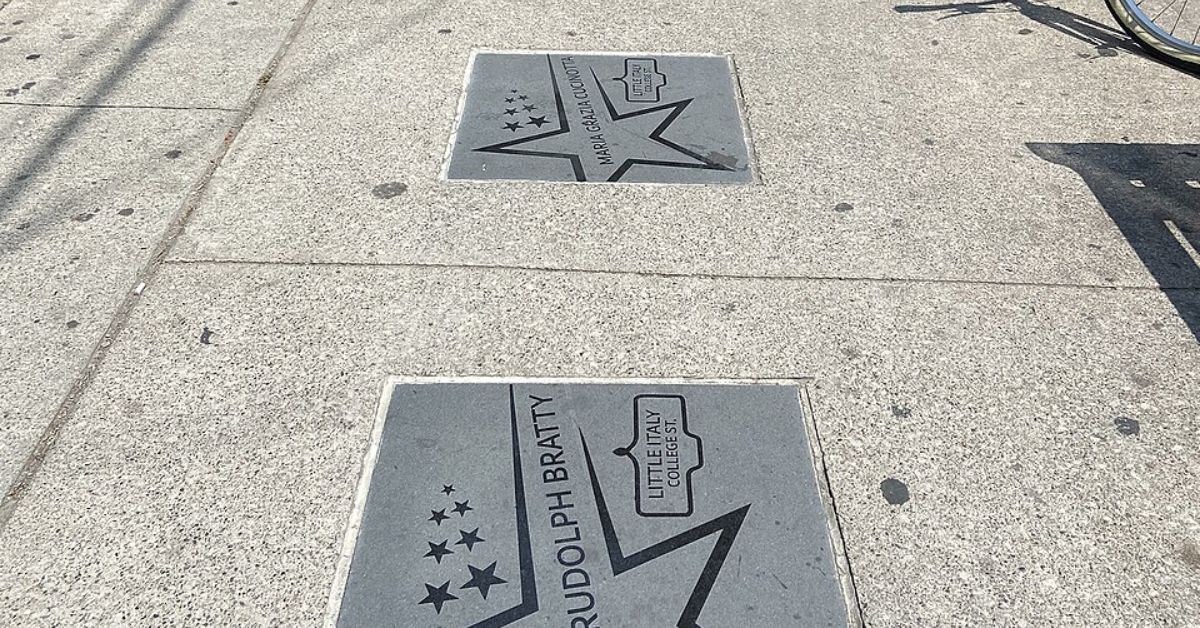
Image Credit: Canmenwalker – CC BY 4.0/Wikimedia Commons
Embedded into the sidewalks of College Street is the Toronto Italian Walk of Fame, a series of plaques honouring Italian-Canadians who have shaped the country. Inductees include musicians, athletes, business leaders, and cultural figures from across the diaspora. Walking the strip and spotting them feels a bit like a treasure hunt with a heritage twist.
The Walk launched in 2009 and continues to add names, which keeps it a living piece of community pride rather than a static monument. Stop and read a few plaques and you start to grasp the breadth of Italian-Canadian contributions to Toronto and beyond. For new arrivals, it is a quick, no-cost crash course in the neighbourhood’s roots.
Palmerston Boulevard
A block east of the College Street action sits Palmerston Boulevard, one of the most photogenic streets in downtown Toronto. The boulevard is lined with Edwardian and Victorian mansions, mature trees, and ornate cast-iron street lamps that look pulled from a Dickens novel. Walk it once and you will understand why it shows up in films and weddings nonstop.
The boulevard was laid out in the early 1900s as one of the city’s prestige addresses, and the bones of that era are still very much intact. Many of the original mansions have been carefully restored, with stained glass, turrets, and grand front porches preserved. For buyers chasing heritage character with serious curb appeal, this stretch is a benchmark for the whole neighbourhood.
Real Estate
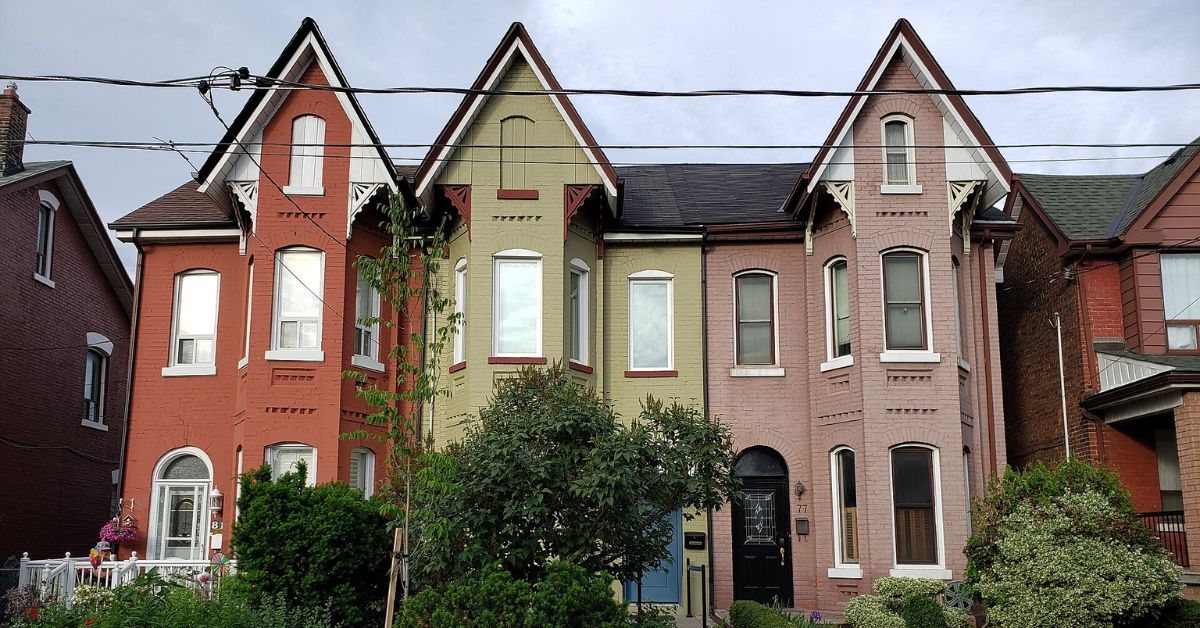
Image Credit: M Canzi – CC BY-SA 2.0/Wikipedia Commons)
Little Italy offers one of Toronto’s largest collections of historic homes. The neighbourhood features Victorian and Edwardian semis, Bay-and-Gable row houses, restored heritage properties, modern infill homes, and condominium developments. Palmerston Boulevard is home to some of the area’s most prestigious residences, with many heritage homes selling for more than $2 million. Recent Palmerston-Little Italy MLS data places the average home price at approximately $1.34 million. Condominium prices vary by building, size, and location, with most listings beginning around $550,000.
The broader Toronto market has shifted toward more balanced conditions through 2026, with prices sitting below their 2022 peak and interest rates easing off. For downtown character neighbourhoods like this one, that has meant more inventory, slightly longer time on market, and real room for negotiation that was not there a few years ago. Sellers are still seeing strong demand for well-kept heritage homes, while buyers have more breathing room than they have had in a long stretch.
There is also genuine range in what you can buy here, which is one of the neighbourhood’s strengths. You will find detached Edwardians on Palmerston, Victorian semis on the side streets, modern condos around the College and Bathurst intersections, and converted multi-unit heritage homes for investors. Whether you are a young professional eyeing a first condo, a growing family after a brick semi with a backyard, or a downsizer wanting a walkable lifestyle, the area has a viable option.
This is exactly where local expertise pays off. Frank Leo and Frank Leo & Associates bring more than 30 years of real estate experience across Toronto and the GTA, and the team knows downtown character neighbourhoods inside and out, from street-by-street pricing to which heritage details actually hold value. They handle the guidance, the market read, and the marketing, plus extras like a free home evaluation and the Guaranteed Home Selling System. Whether you are buying your first condo or selling a Palmerston mansion, get in touch today to start the conversation.
Transportation and Connectivity
For a downtown neighbourhood, Little Italy is well connected without feeling like it sits on top of a highway. The 506 Carlton streetcar runs the full length of College Street and connects east into the downtown core and west toward High Park. Bathurst and Ossington streetcars cap off the east and west ends and link straight up to Bloor-Danforth subway stations.
Spadina and Bathurst stations on Line 1 are the closest subway points, both a short walk or quick streetcar ride away. The 505 Dundas car runs one block south for trips toward Chinatown and the east end. Anywhere downtown is reachable in under twenty minutes without ever touching a car.
Drivers get easy access to Bloor, Bathurst, Spadina, and the Gardiner Expressway for getting in or out of the city. Bike lanes on Harbord, College, and surrounding streets make cycling a real option for daily commuters. Whether you walk, ride, bike, or drive, getting around from here is genuinely simple.
Community and Events
Little Italy has a tight community feel that punches well above its size. Long-time Italian and Portuguese families still anchor parts of the neighbourhood, and you can hear three or four languages on a single block. Newer residents who have moved in for the lifestyle quickly pick up on the unwritten rules: support the local shops, know your barista, say hi to your neighbours.
Taste of Little Italy is the headline event, but the calendar runs hot all year. Outdoor patios light up in summer, the Royal Cinema runs themed screenings, and businesses pitch in on holiday markets and community fundraisers. Even quiet weekends usually have something worth walking out the front door for.
That sense of community is one of the biggest reasons buyers settle here and stay. People raise kids here, retire here, and run small businesses they pass down to the next generation. For anyone after a downtown neighbourhood that still feels like a real neighbourhood, this one delivers.
Dining, Shopping & Local Amenities
This is where Little Italy genuinely earns its reputation. The strip is packed with old-guard Italian trattorias, modern wine bars, small-batch gelaterias, and the kind of espresso bars that take their coffee very seriously. Walk a few blocks in any direction and you will hit Portuguese bakeries, Latin-Canadian groceries, sushi counters, and the food scene of Kensington Market right next door.
Bar Italia, Il Gatto Nero, Bar Raval, Trattoria Taverniti, Contrada, and dozens of newer spots keep the strip full from lunch through last call. Day-to-day shopping is covered by independent grocers, butchers, bakeries, and a Metro on College for the bigger weekly trip. You can essentially live here without a car and want for very little.
Kensington Market sits a short walk east for fresh produce, vintage clothing, and one-off finds. Chinatown is steps beyond that for late-night dim sum or grocery runs. The whole stretch from Little Italy through Kensington and into Chinatown is one of the most walkable, food-rich corridors in the country.
Schools and Family Living
Schools in the area are a mix of public, Catholic, and French-language options, which gives families some real flexibility. Local elementaries pull from the surrounding tree-lined residential streets, and proximity to the University of Toronto means access to a strong network of nearby learning resources. The neighbourhood has shifted in recent years to attract more young families alongside its long-time residents.
Trinity Bellwoods Park, a couple of blocks west, is the closest big green space, with a playground, splash pad, off-leash dog area, and the famous arts crawl in summer. Bickford Park inside Little Italy itself has a community pool, sports fields, and shaded picnic spots that get heavy use in summer. For families weighing a downtown lifestyle, having two real parks within a short walk makes a real difference.
Day-to-day, the area is genuinely walkable for kids. Small ones can scooter to the corner café, school-age kids can bike to the park, and teens can hop a streetcar to anywhere downtown. It is not a sprawling suburban setup, but for families who want city living done well, this one works.
Healthcare and Everyday Essentials
Healthcare access is strong here, anchored by Toronto Western Hospital just a few blocks south on Bathurst. Mount Sinai and Toronto General are also within a short streetcar ride along College for anything more specialized. Family practices, walk-in clinics, dental offices, and pharmacies are scattered across the surrounding streets.
Beyond the hospitals, the neighbourhood is well stocked with the things a downtown household actually uses day to day. Independent pharmacies, opticians, physiotherapists, yoga studios, and a steady mix of gyms all sit within easy walking distance. Combined with the patios, parks, and walkable streets, it is easy to stay active and well looked after.
Add in the everyday conveniences, the grocers, dry cleaners, and small services, and you have a community that covers the practical side too. You get the culture and the energy without losing the basic everyday functionality. That balance is exactly what makes the neighbourhood work for long-term residents.
Final Thoughts
When you add it all up, Little Italy is one of the most distinct neighbourhoods in downtown Toronto. The College Street strip, the heritage homes, the year-round patios, the multicultural depth, and the easy walkability create a lifestyle that genuinely feels like a place, not just an address. It is one of the rare downtown pockets that delivers character and convenience in equal measure.
Best of all, the market timing is working in buyers’ favour right now. With more inventory, prices below their 2022 peak, and rates easing off, there is a real opportunity to get into a neighbourhood that has historically held its value better than most. That is a combination worth paying attention to.
Whether you are after a heritage semi, a Palmerston boulevard mansion, a sleek condo near the streetcar, or simply a real community where you can walk to dinner and know your barista by name, Little Italy has a fit. Lively, layered, and steeped in immigrant history, it is one of the most genuinely interesting places to call home in the entire city. That is the kind of neighbourhood worth putting down roots in.
Contact A Trusted Real Estate Agent in Little Italy
So, one last thing before you go: in a neighbourhood like this, the right real estate agent makes all the difference. Little Italy has its own quirks, from heritage-home maintenance and multi-unit conversions to street-by-street pricing and the difference between a Palmerston frontage and a side-street semi. Having someone experienced in your corner keeps a dream purchase from turning into a headache.
If you are thinking about buying or selling in Little Italy or anywhere in Toronto and the GTA, reach out to Frank Leo and Frank Leo & Associates. With more than 30 years of real estate experience across Toronto and the GTA, the team brings the expertise, guidance, and hands-on support buyers and sellers can count on. You can also take advantage of the Guaranteed Home Selling System and request a free, no-obligation home evaluation to see what your property is worth in today’s market.